 Skip to navigation
Skip to main content


Blog
Shea Butter Grades Explained: Raw vs Refined and What “Grade A” Really Means


Shea butter grades describe how much a butter has been processed. “Grade A” means raw, unrefined butter made with water and heat, the traditional West African way. Refined grades are bleached and deodorised until they are white and odourless. The letters are a trade convention, not an official standard, so the way to judge a batch is by its colour, smell, texture and paperwork, not the letter on the label.
Recommended for this guide
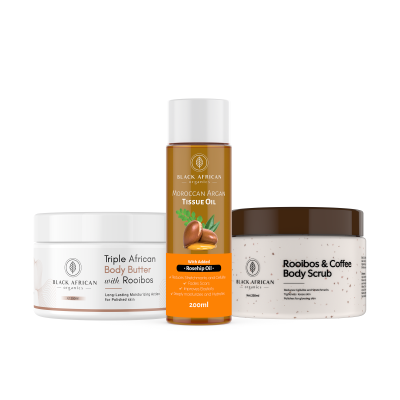
Argan Tissue Oil + Rooibos & Coffee Scrub Body Kit for Stretch Marks & Cellulite (3 Products)
Tissue oil plus rooibos and coffee scrub: a complete kit for stretch marks and cellulite.
Where the grades come from
The A-to-E (sometimes A-to-F) letter scale was popularised by US trade bodies and aid programmes working with shea producers. It is not a legal or international standard, and sources describe the middle grades differently. In most online listings, the seller chooses the letter. Ghana, where our shea comes from, has its own national standard run by the Ghana Standards Authority, which grades butter on laboratory measurements rather than a seller’s label.
The grades at a glance
| Grade | What it means | Colour and smell | Typical use |
|---|---|---|---|
| A (raw, unrefined) | Extracted with water and heat, nothing removed | Ivory to cream, sometimes greyish yellow; nutty, slightly smoky smell | Body butters, hair butters, balms, soap, resale |
| B (refined) | Filtered and deodorised | Paler, little or no smell | Lotions and creams where scent must be neutral |
| C (highly refined) | Extracted or refined with solvents such as hexane | Pure white, no smell | Mass-market cosmetics |
| D and E | Lowest grades; E contains contaminants | Varies | Not for skincare |
Refining makes butter more uniform and removes impurities, but it also strips much of the natural vitamin content, along with the smell and colour.
Shop the products in this guide
★ Bestseller
Argan Tissue Oil + Rooibos & Coffee Scrub Body Kit for Stretch Marks & Cellulite (3 Products)
✨ Why your curves will love you:
✔️ ☕ Exfoliates & boosts circulation with coffee & rooibos
✔️ 🌹 Rosehip oil helps soften the look of stretch marks and scars
✔️ 💧 Deeply hydrates & softens with Moroccan argan oil
✔️ 🌿 Improves skin texture, tone & elasticity
✔️ ✅ Natural, non-greasy & safe for all skin types
✔️ 🧴 Perfect for pregnancy, weight loss & daily body care

Moroccan Argan, Vitamin E & Rosehip Organic Tissue Oil for Stretch Marks, Scars & Dry Skin 200ml
Unrefined or refined: which should you buy?
- Buy unrefined if you are making whipped body butter, hair butter, balms or soap, or reselling raw shea. Your customers expect the natural smell and colour, and it keeps more of what makes shea worth buying.
- Consider refined if you are making a lightly scented lotion where the nutty smell would clash with your fragrance, or if you need a pure white product.
How to check a batch of raw shea butter
- Colour. Raw shea is ivory to cream. Pure white butter has been refined, whatever the label says.
- Smell. Expect an earthy, nutty, faintly smoky smell from the roasting step. Unrefined butter that smells of nothing has been refined at some stage. A sour or rancid smell means old or badly stored butter.
- Texture. It should be firm but soft enough to scoop, and melt when you rub it between your fingers. Raw shea can feel a little grainy; that is normal and smooths out when melted and cooled quickly.
- Cleanliness. Small specks are normal in handmade butter. Lots of grit, bark or fibre means poor filtering.
- Paperwork. For larger orders, ask your supplier for a certificate of analysis showing moisture, free fatty acids and peroxide value, and whether any solvent was used.
Why is some shea butter yellow?
Raw shea butter is naturally ivory to cream. Bright yellow shea is often coloured with borututu root or palm oil during processing, a common practice in parts of West Africa. Yellow shea is not necessarily bad, but it is not “more natural” than ivory shea, and you should know what you are buying and selling.
How to store shea butter
- Keep it sealed, in a cool, dark place, away from direct sun and heat.
- Scoop with a clean, dry spatula so no water gets into the tub.
- When you repackage, write the batch number and packing date on each container.
Buying raw shea butter in bulk
Our raw unrefined shea butter comes from Ghana and is sold from 1kg, with the price per kg falling as you buy more:
| Size | Price | Price per kg |
|---|---|---|
| 1kg | R420 | R420 |
| 5kg | R1,850 | R370 |
| 10kg | R3,200 | R320 |
| 20kg | R6,000 | R300 |
| 50kg | R14,000 | R280 |
Start with 1kg to check the colour, smell and texture against the list above, then scale up. For black soap and other raw ingredients, see our wholesale shop and our guide to buying black soap and shea butter in bulk.
Shea butter grade FAQs
Is Grade A shea butter certified?
Usually not. “Grade A” is normally the seller’s own description of raw, unrefined butter. Judge the butter itself and ask for a certificate of analysis on big orders.
Is unrefined shea butter better for skin?
Unrefined butter keeps more of its natural vitamins and fatty acids, which is why it is preferred for natural skincare. Refined butter is still a good moisturiser, with a neutral smell.
Why does my shea butter feel grainy?
Graininess happens when shea melts and cools slowly. It is harmless. Melt it gently, then cool it quickly in the fridge to make it smooth again.
Can I resell raw shea butter under my own brand?
Yes, many of our wholesale customers do. Label each container with the ingredient name, weight, batch number and your contact details, and check the current South African cosmetics labelling rules before you sell.
Want to use it on hair? Read how to use shea butter on dry natural hair.
Written by the Black African Organics team. General product information, not professional advice.
Sources
- Shea butter: grades, colour and composition (Wikipedia)
- Shea Butter Grades Explained (Baraka Shea Butter)
Shop the routine
★ Bestseller
Argan Tissue Oil + Rooibos & Coffee Scrub Body Kit for Stretch Marks & Cellulite (3 Products)
✨ Why your curves will love you:
✔️ ☕ Exfoliates & boosts circulation with coffee & rooibos
✔️ 🌹 Rosehip oil helps soften the look of stretch marks and scars
✔️ 💧 Deeply hydrates & softens with Moroccan argan oil
✔️ 🌿 Improves skin texture, tone & elasticity
✔️ ✅ Natural, non-greasy & safe for all skin types
✔️ 🧴 Perfect for pregnancy, weight loss & daily body care
Moroccan Argan, Vitamin E & Rosehip Organic Tissue Oil for Stretch Marks, Scars & Dry Skin 200ml

Deep Moisturizing Rooibos Infused African Shea Body Butter 250ml

Urea & Lavender Deep Moisture Butter for Dry, Itchy-Feeling & Eczema-Prone Skin 250ml
✨ Key Benefits:
✔️ 💧 Deeply moisturizes dry, flaky & irritated skin
✔️ 🌿 Moisturises dry, rough and eczema-prone skin
✔️ 💜 Soothes with natural lavender oil
✔️ 🔬 Urea helps soften rough, dry skin
✔️ 🚫 No perfume, no colorants, no preservatives
✔️ 👶 Gentle formula (patch test first; ask a pharmacist before using on babies) — even sensitive skin